

–:– / –:–
This voice experience is generated by AI. Learn more.
This voice experience is generated by AI. Learn more.
Summary
The Pentagon announced new framework agreements with Lockheed Martin and General Dynamics to drastically increase interceptor missile production. These deals are part of a months-long push to quadruple THAAD and triple PAC-3 MSE missile output and come amid a need to avoid critical shortfalls in U.S. munitions stockpiles. The interceptor missile systems remain a crucial element in modern warfare and play a vital role in the successful defense of U.S. strategic assets worldwide. They are designed to intercept diverse incoming aerial threats, including large unmanned aircraft systems, incoming ballistic missiles, and space-borne missiles.

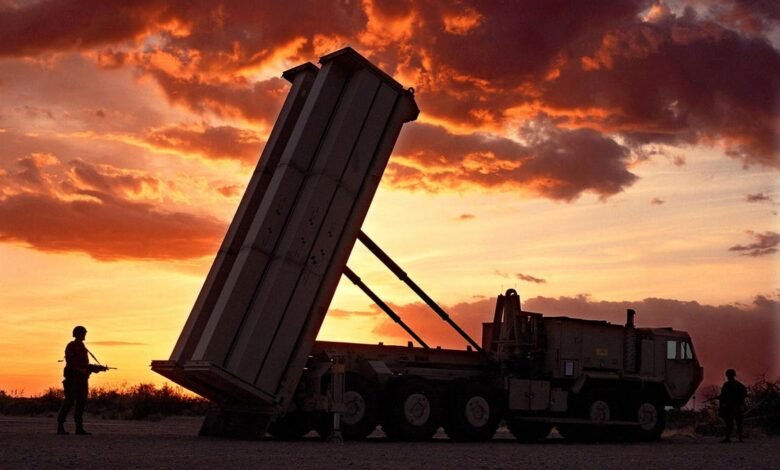
The Pentagon announced an additional framework agreement to increase production of Patriot and THAAD missile interceptors. The THAAD system, shown here, is the only U.S. interceptor missile capable of destroying inbound enemy missiles in outer space as well as from within Earth’s atmosphere. (Lockheed Martin)
The Pentagon today announced the signing of two framework agreements aimed to increase production of interceptor missile components.
The agreements with Lockheed Martin and General Dynamics
The agreements with Lockheed Martin and General Dynamics have the stated goals of quadrupling the production rate of Terminal High Altitude Area Defense interceptors, known as THAADs, and tripling production of Patriot Advanced Capability-3 Missile Segment Enhancement interceptors, known as PAC-3 or Patriot missiles.
“Today’s announcement represents an example of the evolution of how we partner with industry to expand the Arsenal of Freedom, outpace emerging threats, and ensure the Warfighter never faces a fair fight,” said Michael P. Duffey, Under Secretary of War for Acquisition and Sustainment, in a release.
The announcement is the latest in a long-running series of efforts to rapidly boost missile production, reflecting an ongoing need for steady missile supplies.
On January 6, Lockheed announced a framework agreement
On January 6, Lockheed announced a framework agreement with the Pentagon to triple the PAC-3 MSE production rate to over 2,000 a year.
The Pentagon followed this with a framework agreement with Lockheed Martin announced January 29 aiming to quadrupleTHAAD production from 96 to 400 interceptors annually.
In March, the Pentagon announced three framework agreements with BAE Systems, Lockheed, and Honeywell Aerospace to accelerate the development of missile components. According to the stated goals of those agreements, Lockheed would quadruplePrecision Strike Missiles, or PRsMs, and work with BAE Systems to increaseproduction of THAADs also to a quadruple rate.
In April, the Pentagon and Boeing agreedon
In April, the Pentagon and Boeing agreedon a seven-year framework to triple seekers used on PAC-3 missiles that enable them to intercept targets.
This was followed by an additional multi-year framework agreement between the Pentagon, L3Harris, and Lockheed to quadruple THAAD missile propulsion systems.
On August 3, the Pentagon announced a $3 billion agreement with Northrop Grumman to quadruple THAAD missile components in San Diego.
The PAC-3 MSEs and THAAD systems represent
The PAC-3 MSEs and THAAD systems represent the cutting-edge of American missile defense technology. Although low-cost drones are coming to the fore of modern combat, these interceptor missiles possess vital abilities not only to project firepower but defend U.S. assets of strategic significance on the global stage.
Both missile interceptors are designed to protect U.S. and allied troops, civilians and infrastructure by knocking hostile aerial threats – such as incoming missiles, aircraft and large drones – out of the sky.
The PAC-3 is a missile type produced by Lockheed in diverse variations. The PAC-3 MSE model now in urgent demand by the Pentagon can fly farther and reach higher altitudes to strike targets due to its two-pulse solid rocket motor.
The THAAD missiles produced by Lockheed
The THAAD missiles produced by Lockheed are the onlyU.S. interceptors capable of striking down missiles attacking from outer space as well as from within Earth’s atmosphere.
The multiple agreements come as the U.S. is reported to be facing a dire shortage of missiles.
Addressing members of the Senate Appropriations Committee on July 21, Defense Secretary Pete Hegseth said the Pentagon needed $67.1 to cover expenses to prevent shortfalls, including of munitions used in military operations.
Without these funds, we face critical shortfalls
“Without these funds, we face critical shortfalls that threaten our ability to also simply pay our service members, rapidly replenish equipment and munitions, and sustain vital operations without disruption,” he told lawmakers.
Following the announcement of its latest framework agreement, the Pentagon announced several additional initiatives to ramp up defense technology production including a $174 million investmentin a gallium production facility in Australia and a $37.2 million contract to produce copper foil for microelectronics.
The Pentagon’s emphasis on missile production and acquisition demonstrates the extent to which sophisticated interceptors remain an essential component of modern warfare and U.S. defense despite recent advances in low-cost unmanned aircraft systems.
Editorial StandardsReprints & Permissions
Source: www.forbes.com